How the 5A Coaching Model Can Transform Your Team
Most team leaders I meet have good instincts about coaching. They know they should be asking more questions and giving fewer answers. They know teams grow faster when they work things out for themselves. They’ve probably been on a course or two, read a book, watched a video.
And then they get back to Monday morning, and the doing takes over. Coaching becomes one of those things you’ll get to once things calm down — which, of course, they never do.
If that sounds familiar, the 5A Coaching Model might be the most useful thing you read this week. It’s the model we use at The Team Space, grounded in the ORSC™ (Organisation & Relationship Systems Coaching) methodology — an ICF-accredited approach to working with teams. I’ve been using it with teams and leaders for years. It hasn’t lost its power yet. It’s simple enough to remember in the middle of a conversation and structured enough to keep you out of your own way.
What is the 5A Model?
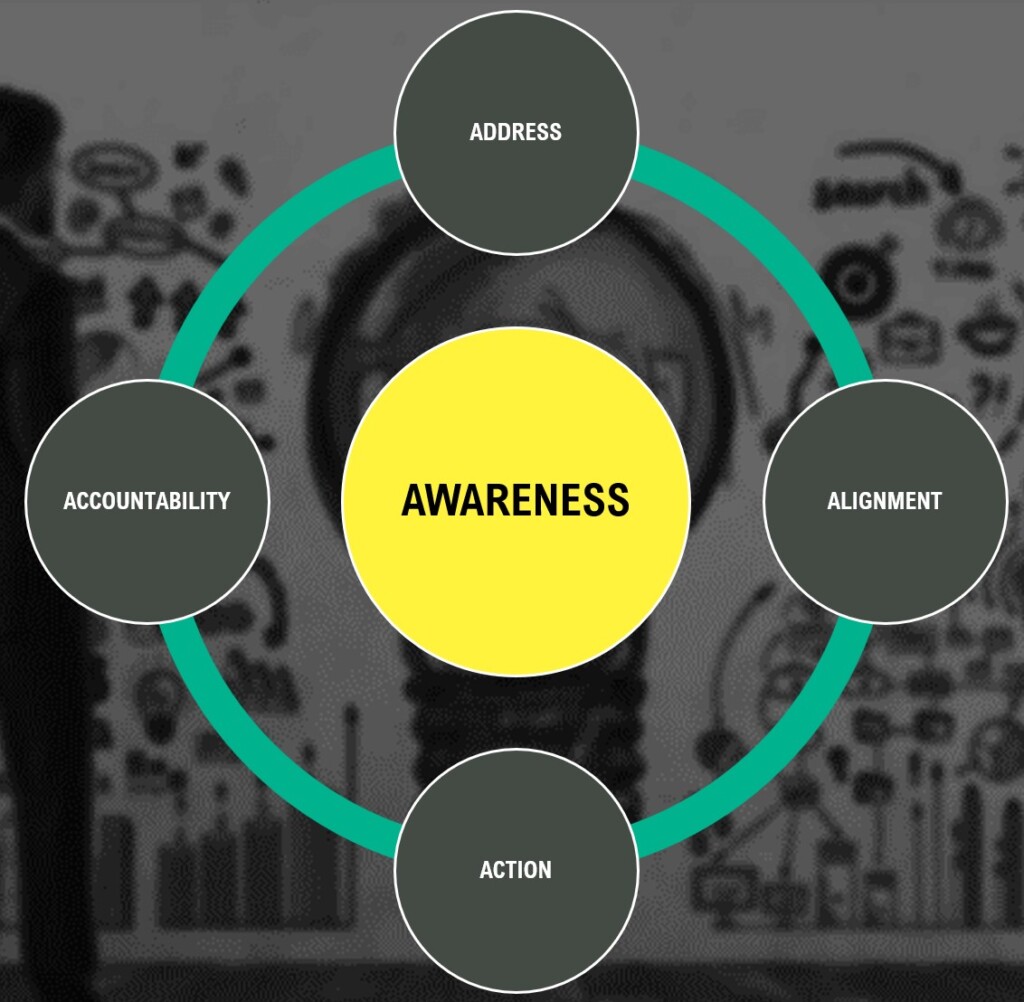
The 5A Model is a five-stage framework for coaching a team — not for coaching individuals one at a time in a room together, but for working with the team as a single entity. That distinction matters, and we’ll come back to it. The five stages are:
- Awareness — make the team fully conscious of what’s actually going on
- Address — get the real conversations into the open
- Alignment — bring the team together as a unified whole
- Action — co-create a concrete plan the team commits to
- Accountable — cement the plan and build mutual accountability
Five stages. A sequence that works because it respects how teams actually change — which is slower, more honest, and more collective than most leadership advice wants to admit.
Why the order matters
The reason 5A works is that it stops teams jumping straight to the action — which is where almost every well-meaning intervention falls over.
Think about most team meetings. Someone raises a problem. Within a minute or two, people are debating solutions. Someone writes “actions” on the whiteboard, owners are assigned, the meeting ends, and — surprisingly often — nothing much changes. Why? Because the team leapt to Action before it had done the real work of Awareness, Address and Alignment. The plan may be perfectly sensible, but the team isn’t ready to carry it.
5A forces you to slow down. You don’t get to Action until you’ve earned the right to, and you earn that right by doing the earlier stages properly. It feels counterintuitive at first — especially if you’re naturally a doer — but the results are dramatic. Teams leave with more clarity, more ownership, and a plan they’ve genuinely committed to rather than one they’ve politely agreed with.
The five stages in practice
1. Awareness
Awareness is the greatest agent for change. Most teams have a level of awareness around their issues already — but they aren’t talking about the elephant in the room. Or they can’t quite see what they need to. The first job of the coach is to make the team fully conscious of all the challenges and concerns that need to be addressed.
That means the team seeing itself clearly — as a team. Not ten individuals with different views, but one entity with a pattern of behaviour. What are we actually like when we’re together? What are we avoiding? What’s everyone seeing but no one is saying?
Good Awareness work sounds like: “What are we noticing about how we’re operating?” “What’s the thing we’re all thinking but not saying?” “When we look at ourselves as a team, what do we see?”
Get this stage right and the team starts the rest of the journey from honesty. Get it wrong and everything that follows is built on something that isn’t quite true.
2. Address
Once the team can see what’s happening, it has to face it. That means getting things into the open — having the conversations, exploring the problem, saying the thing. It’s daunting, and that’s why a coach is useful: to hold the space so the dialogue stays honest, respectful and productive, rather than becoming negative or pointless.
Address is where the team does the grown-up work of actually engaging with the issues it has just become aware of. That might be a long-avoided tension, a disagreement about direction, an unacknowledged frustration with how decisions are being made. Whatever it is, it has to come out of the shadows.
Many teams skip this step because it’s uncomfortable. The cost of skipping it is high: the unaddressed issue continues to leak into everything the team does, dressed up as something else.
3. Alignment
Once the team has consciously and intentionally worked through its issues, the coach helps bring the team together as an aligned unit. This matters especially when there are silos, divisions, or factions within the team. An aligned team is one that’s unified behind a common desire to move forward — not unified in the sense that everyone agrees, but unified in the sense that everyone is pulling the same direction.
Alignment looks like the team rediscovering a shared sense of purpose: what are we actually here for? Where do we want to get to? What are we building together? This stage is surprisingly emotional when it goes well. After the honesty of Address, the move into Alignment often has a sense of relief about it — the team finding itself again.
4. Action
Now — and only now — does the team co-create its action plan. The fact that the team comes up with the plan itself, rather than being told what to do, is tremendously powerful. The actions are specific, concrete behavioural practices that the team has identified as essential to the change it wants to see.
There’s a reason this stage comes fourth. If you’ve done Awareness, Address and Alignment properly, the actions almost write themselves. The team knows what needs to change. It has faced what needs to be said. It has agreed on where it’s going. Action is just the team putting into words what it already knows it needs to do.
Skip the earlier stages, and Action becomes a list of good ideas that don’t stick. Do the earlier stages well, and Action becomes a plan the team actually owns.
5. Accountable
The final stage is where one-off coaching becomes lasting change. Because the team has worked through the earlier steps, it has a plan it has created itself. The coach’s job now is to cement that plan so every member is committed and clear on what they — and everyone else — need to do.
The real power of 5A is revealed here: the team holds itself accountable. Not because a leader is enforcing the plan, but because the team has built commitment into the plan during the coaching. People don’t want to let each other down on something they created together.
This is also where the Ebbinghaus Forgetting Curve gets interrupted. We know that we forget 90% of what we learn within 30 days — so building in regular check-ins, rituals and rhythms is essential. Accountable isn’t a one-off moment. It’s the beginning of a new way of the team working.
Why 5A treats the team — not the individual — as the client
The thing that makes 5A distinctive isn’t just the sequence. It’s the assumption underneath it: that the team itself is the client, not the individuals who make it up.
Most leadership development is built around improving individuals. 5A works differently. It creates unique insights into the relationships and connectivity within the team — the patterns between people, not just the performance of each person. It assumes that all the voices of the team are valid and need to be heard. And it trusts that the team, given the right conditions, will find its own answers — because teams are naturally creative, resourceful and intelligent.
That’s a meaningful shift. It moves the leader from “I need to fix each of my people” to “I need to help my team think and work better together.” The second job is easier, cheaper, and far more effective.
The shift it makes
I’ve watched the 5A Model change teams. Not overnight, and not dramatically, but noticeably. The conversations get more honest. The decisions get sharper. The silos quietly soften. And the leader’s job shifts from carrying the team to being part of it.
If you’re going to try one thing this fortnight, try this: the next time your team faces a real issue, resist the urge to jump to Action. Spend proper time on Awareness — what are we actually seeing? Then Address — what do we need to put on the table? Then Alignment — what do we agree on going forward? Only then, get to Action.
It’ll feel slow. It’ll feel like you’re not making progress. You’ll be wrong about that.
In the next post, we’re going to step back from frameworks and look more broadly at what good team coaching actually looks like — beyond models, and into the everyday behaviours that make the difference. Read it here.
HOW TO GET IN TOUCH
Call me on +971 (0)50 559 5711 or send me a message